From Vision to Investable: KAFD's SAR 12 Billion Murabaha and the Privatization of Gulf Project Finance
Macro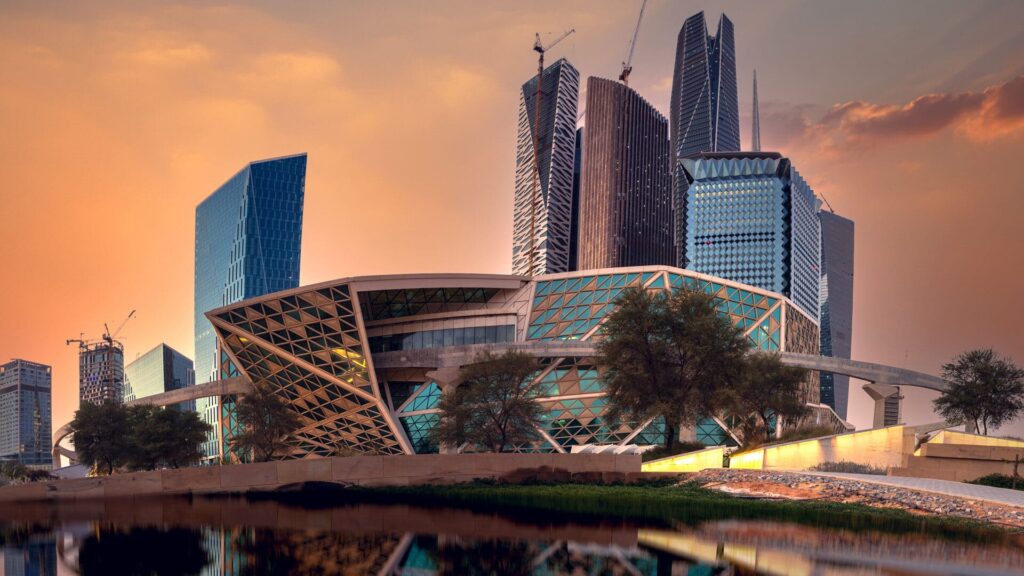
King Abdullah Financial District Development and Management Company (KAFD DMC) closed a SAR 12 billion ($3.2 billion) senior-secured Murabaha facility in June 2026. A 10-bank syndicate absorbed the full facility on an oversubscribed book, marking the first time KAFD DMC has raised secured debt on its own balance sheet without a PIF backstop. The deal is one of the largest private-sector real estate financings in Saudi history. The structure and broad domestic demand for the debt signal successful entry into the next phase of maturation for large Vision 2030 giga-projects — standing on their own two feet.
The Structure
KAFD DMC’s SAR 12 billion senior-secured Murabaha facility carries a 15-year tenure and marks the company’s first independently secured debt facility — one of the largest private-sector real estate financing transactions in the Kingdom. The structuring mandate went to Al Rajhi Capital as sole advisor. Mandated lead arrangers included Al Rajhi Bank, Saudi Awwal Bank, Saudi National Bank, Riyad Bank, Alinma Bank, Arab National Bank, and Gulf International Bank — Saudi Arabia, with Bank Albilad, Mashreqbank PSC, and National Bank of Kuwait acting as bookrunners (Zawya.com).
What Is Murabaha?
Murabaha is a cost-plus sale. The bank purchases a commodity asset, or collection of assets, at spot price, then immediately resells it to the borrower at a disclosed markup — payment deferred over the facility tenor. The borrower sells the commodity immediately on the open market to raise cash now, and repays the bank’s marked up price in installments over the length of the agreement. No interest changes hands at any point. Every transaction is a sale of a real asset. The bank’s profit margin is the economic equivalent of a lending rate, but structure as Shariah-compliant sale profit.
In KAFD’s case: the 10-bank syndicate acquired a publicly undisclosed commodity asset, resold it to KAFD DMC at cost plus an agreed profit margin with payment deferred over 15 years. KAFD immediately sold that asset on the open market to receive approximately SAR 12 billion in liquidity. KAFD now services the facility from operating cash flows — rental income from its 140-plus office tenants, residential units, hotels, and retail. The “senior-secured” designation means KAFD’s existing real estate portfolio backs the obligation directly as collateral.
The Threshold For Independence
This is the first debt financing secured by KAFD DMC independently of its state backer — the Saudi Public Investment Fund. Until now, KAFD’s capital needs were met through PIF equity or sovereign-backed channels. Accessing a 10-bank syndicate on its own balance sheet signals that KAFD has crossed a threshold: it now carries enough operational track record, rental cash flows, and asset quality to support standalone credit underwriting from private domestic markets.
The order book was oversubscribed. Oversubscription on a SAR 12 billion ticket indicates genuine trust and appetite in a domestic market where foreign banks have largely stayed on the sidelines of Saudi megaprojects and left local liquidity as the sole source for potential demand for fixed income assets. Al Rajhi Capital’s CEO described the demand as a clear testament to KAFD’s market positioning and business fundamentals.
The Islamic Finance Context
The KAFD facility lands inside a rapidly expanding market. Saudi Arabia controlled nearly half of the Middle East Islamic finance market in 2025, with NEOM, the Red Sea Project, and Riyadh Metro collectively generating multi-decade sukuk and syndicated Murabaha pipelines that anchor domestic asset growth. Saudi banks are being asked to absorb an unprecedented volume of long-duration Vision 2030 paper. The 15-year KAFD facility sits at the upper end of typical Murabaha tenors, and the fact that ten institutions cleared the book suggests domestic banks have appetite well beyond the sovereign-guaranteed tier.
One structural risk worth monitoring: AAOIFI’s proposed Standard 62 could disrupt Islamic finance markets from 2026 onward by increasing the strictness of certain Sharia-compliant instruments, namely sukuk, potentially increasing pricing for issuers and fragmenting the investor base. Corporate Murabaha facilities like KAFD’s are structured differently, but any reclassification that shifts pricing dynamics across Sharia-compliant instruments would affect refinancing costs across the board.
Use of Proceeds
Proceeds will fund continued development across KAFD’s five asset classes — commercial, residential, hospitality, retail, and lifestyle — while strengthening the company’s capital structure and accelerating strategic projects across the district. KAFD currently hosts more than 140 office tenants and over 75 regional headquarters for multinational companies. Planned expansion includes adding 1 million square meters of office space and 1,000 residential units, alongside an internal monorail scheduled for public operations in 2027.
Watch the KAFD DMC credit story as a leading indicator for Vision 2030 asset monetization. If the 15-year Murabaha performs and refinancing risk stays contained, expect other PIF subsidiaries to follow with standalone debt raises. Foreign bank participation in the next round — currently absent from this syndicate — is the next phase of generalized maturation across Vision 2030 asset classes.
The KAFD Murabaha facility is a test of whether Vision 2030’s flagship assets can function as investable credit platforms — borrowing on their own merits rather than against a sovereign guarantee. The oversubscribed book suggests the answer, for KAFD in this cycle at least, is yes. Saudi banks are willing to extend 15-year tenor to a PIF subsidiary on standalone fundamentals. If that model holds and replicates across other giga-project operators, it meaningfully reduces the fiscal burden on PIF and opens a private capital channel that Vision 2030 will need at scale. The next question is whether foreign institutions eventually join that market, or continue to watch from outside.
Sources: KAFD DMC press release via Tadawul, June 2026. Argaam. Zawya. Middle East Construction News. AGBI. SaudiGulf Projects. IndexBox. Mordor Intelligence Islamic Finance Market Report 2026. S&P Global Islamic Finance Outlook.